
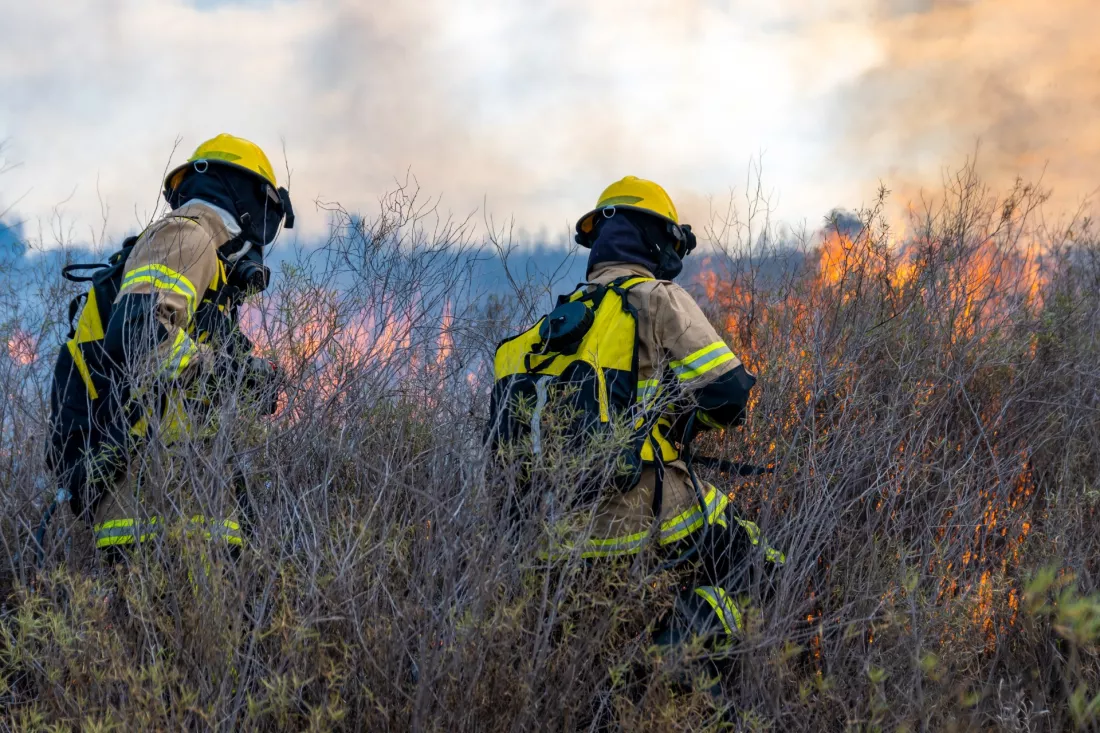
In the summer of 2025 more than a million hectares burned in Europe. Scientists from the EU’s FIRE-RES project argue that simply putting out fires is no longer enough, and that wildfires have to be managed long before the first smoke appears. In 11 Living Labs they checked how grazing animals, drones, pseudo-satellites and even local wine can help – and at the end you can find out whether you think about protecting the landscape like a strategist, or more like a viewer of the evening news.
Here is a number that impresses: in the summer of 2025 the total burnt area in Europe reached 1,034,552 hectares. According to CORDIS, it was one of the worst seasons for damage caused by wildfires and a marked increase on the previous year.
Wildfires are becoming more frequent and more intense. Increasingly they threaten not only nature but people as well. That is exactly why the FIRE-RES project team decided to look at the problem more broadly than through the windscreen of a fire engine.
For years the strategy was simple: detect the fire and put it out as quickly as possible. Today, as the project’s authors point out, that approach is no longer enough. FIRE-RES coordinator Antoni Trasobares puts it plainly: “FIRE-RES promotes a shift towards landscape resilience and integrated fire management (IFM).”
In practice this means that a wildfire stops being treated as an isolated emergency. It becomes part of a broader socio-ecological system in which nature and people are closely linked.
Integrated fire management brings together, as one whole, stages that are usually thought of separately:
Just as important is who takes part in this work. Not only firefighters, but also farmers, foresters, land planners and local communities. Each of these groups knows the terrain differently and has different ways to act – and each can contribute its share.
To check whether these ideas work outside the conference room, the team set up 11 Living Labs in the European Union and in Chile. These are places where solutions are tested in real conditions.
In total, 34 innovative actions were carried out there. Many of them combine grazing, forestry and farming. Such a combination reduces the amount of vegetation fuel that could catch fire and creates natural fire breaks.
One of the more interesting strands of the project concerns money. The researchers tested mechanisms that encourage landscape care by linking fire-resilient land management to local value chains.
An example? The Fire Wine brand. It shows that preventing wildfires can bring real financial benefits for local communities. Trasobares stresses: “These solutions not only lower fire risk but can also support rural livelihoods by linking wildfire prevention to productive land use.”
The second pillar is technology. Together with end users, the project developed and tested, among other things:
What is it all for? “By providing more accurate and timely information, these tools help authorities plan interventions, allocate firefighting resources more effectively and improve safety for response teams,” Trasobares explains.
The project did not shut itself away among its own experts. In parallel ran the Open Innovation Challenge, an open call in which innovators, entrepreneurs and researchers could submit their solutions. Some of these proposals can be integrated into real operational workflows.
This is good news for anyone thinking about working where technology meets environmental protection. In the fight against wildfires we need not only people in helmets, but also those who can build tools and work with data.
The benefits do not end with a lower wildfire risk. The project helps protect ecosystems that matter for carbon storage, biodiversity and local livelihoods. It also supports EU goals: reducing accidental fires, cutting emissions and making protected areas more resilient.
According to CORDIS, the work of FIRE-RES provides a solid basis for implementing the EU Nature Restoration Regulation.
The project, coordinated by Spain’s Centre de Ciència i Tecnologia Forestal de Catalunya, ran from December 2021 to November 2025. Its effects are meant to last much longer, though. The extended network of Living Labs is to keep spreading proven practices and sharing knowledge.
“FIRE-RES aims not only to deliver new tools but also to build a lasting culture of integrated wildfire management across the continent,” the coordinator says.
FIRE-RES shows that wildfires cannot be beaten with a fire hose alone. What counts is what happens all year round: grazing, wise land management, accurate risk maps and cooperation among many groups. For students this is an important lesson – the safety of landscapes is a field where ecology, economics and new technology meet.
5 questions · one minute


 English
 Čeština
 Deutsch
 Español
 Français
 Magyar
 Italiano
 Polski
 Português
 Русский
 Slovenčina
 Türkçe
 Українська
 العربية
 中文