
They weigh less than 50 grams, fly thousands of kilometres at night and find their wintering grounds without any map. For over half a century, migratory songbirds have posed scientists the same puzzle: how do they sense Earth’s weak magnetic field? The QuantumBirds team is testing an answer that sounds like science fiction: the compass may sit in the bird’s eye and work through quantum effects — and at the end you can find out what kind of navigator you are when your phone loses its signal.
Migratory songbirds are true lightweights. They weigh less than 50 grams, yet every year they cover thousands of kilometres at night to reach their wintering grounds. On the way they rely on several navigation systems at once: they watch the stars, remember landmarks and follow their sense of smell. On top of that, they can sense the direction of Earth’s weak magnetic field.
And here the problem begins. Research into this sense has been going on for more than 50 years, and the mechanism is still unknown. We know that it works. We do not know how.
It is exactly this question that the QuantumBirds project took on. It is funded by the European Research Council and coordinated by the University of Oxford. For seven years, specialists from very different fields worked in it: quantum mechanics, spin chemistry, behavioural biology and biochemistry.
The hypothesis they tested is bold. Birds would literally see the magnetic field thanks to chemical reactions taking place in the eye. Peter Hore, one of the project’s principal investigators, does not hide that it sounds strange: “At first glance, the notion that a chemical reaction could serve as a compass seems preposterous.”
No wonder. As Hore explains, the strength of the interaction between a single molecule and Earth’s magnetic field is only a millionth of the strength of a typical chemical bond. Such a stimulus seems far too weak to change anything.
The key lies in proteins called cryptochromes, found in birds’ retinas. According to the researchers, light triggers the formation in them of radical pairs – short-lived molecular systems in which things happen that you would expect to find in a quantum physics textbook rather than in biology.
“When light hits these proteins, the generated radical pairs exist in a quantum superposition state,” explains Peter Hore. And he adds: “Given this delicate quantum state, the yield of the chemical reaction is highly sensitive to the direction of an external magnetic field.”
In other words: how efficiently the reaction runs depends on how the bird is positioned relative to Earth’s field. And because everything happens in the eye, the information arrives right where it is needed. “This effectively encodes navigation data directly into the bird’s visual system,” says Hore.
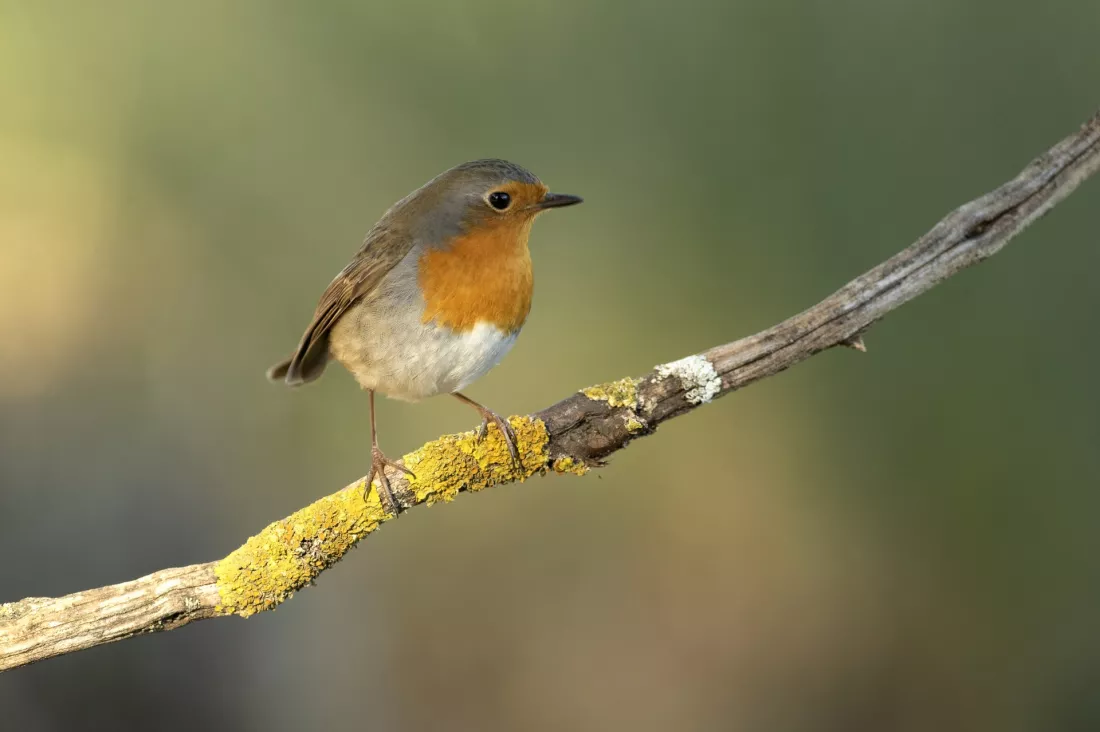
Theory is one thing, but proof was needed. The team showed that cryptochrome-4a found in the European robin is sensitive to weak magnetic fields. The researchers regard this as the first direct evidence that this molecule has such a property. For the quantum compass hypothesis, it is a strong foothold.
To look so deep into a bird’s eye, the scientists first had to build their own tools. They included:
The last of these is especially important, because it lets researchers observe not only the proteins themselves but also the response of nerve cells.
Something surprising came to light along the way. The inner part of a bird’s retina operates under a constant shortage of oxygen. This discovery explains why research on this part of the eye has gone so slowly over the past decades: conditions in the laboratory simply did not match those in a living organism.
Now the scientists are preparing an experiment meant to settle the matter. “We are on the brink of a definitive answer through conducting a sophisticated isotopic swap,” announces Henrik Mouritsen, the other principal investigator.
The idea is to replace the natural carbon-12 in the flavin molecules in a bird’s eye with heavier carbon-13. Computer simulations showed that such a swap should change how birds respond to disruption caused by radio waves. The team has already created a way to introduce flavins with carbon-13 into birds’ eyes and is carrying out behavioural tests to show whether the change affects their sense of orientation.
The stakes are high. “A successful result will provide undeniable proof of this quantum compass,” stresses Mouritsen.
Although this is basic research, its results may prove useful in surprisingly practical matters. Understanding how migratory birds choose their direction could help steer them towards habitats resilient to climate change instead of degraded areas. Similar mechanisms also operate in organic light-emitting diodes, so cheap and non-toxic magnetic sensors could be built on this basis. Another idea is navigation systems that cope where the GPS signal is blocked or disrupted.
Songbirds may carry in their eyes a compass that works thanks to quantum physics. The QuantumBirds team showed that the robin’s cryptochrome-4a protein responds to a weak magnetic field, built new equipment for studying the retina and discovered that its inner part lives with a shortage of oxygen. The carbon-swap experiment is meant to give the final answer and, along the way, suggest ideas for nature conservation and navigation without GPS.
5 questions · one minute


 English
 Čeština
 Deutsch
 Español
 Français
 Magyar
 Italiano
 Polski
 Português
 Русский
 Slovenčina
 Türkçe
 Українська
 العربية
 中文